
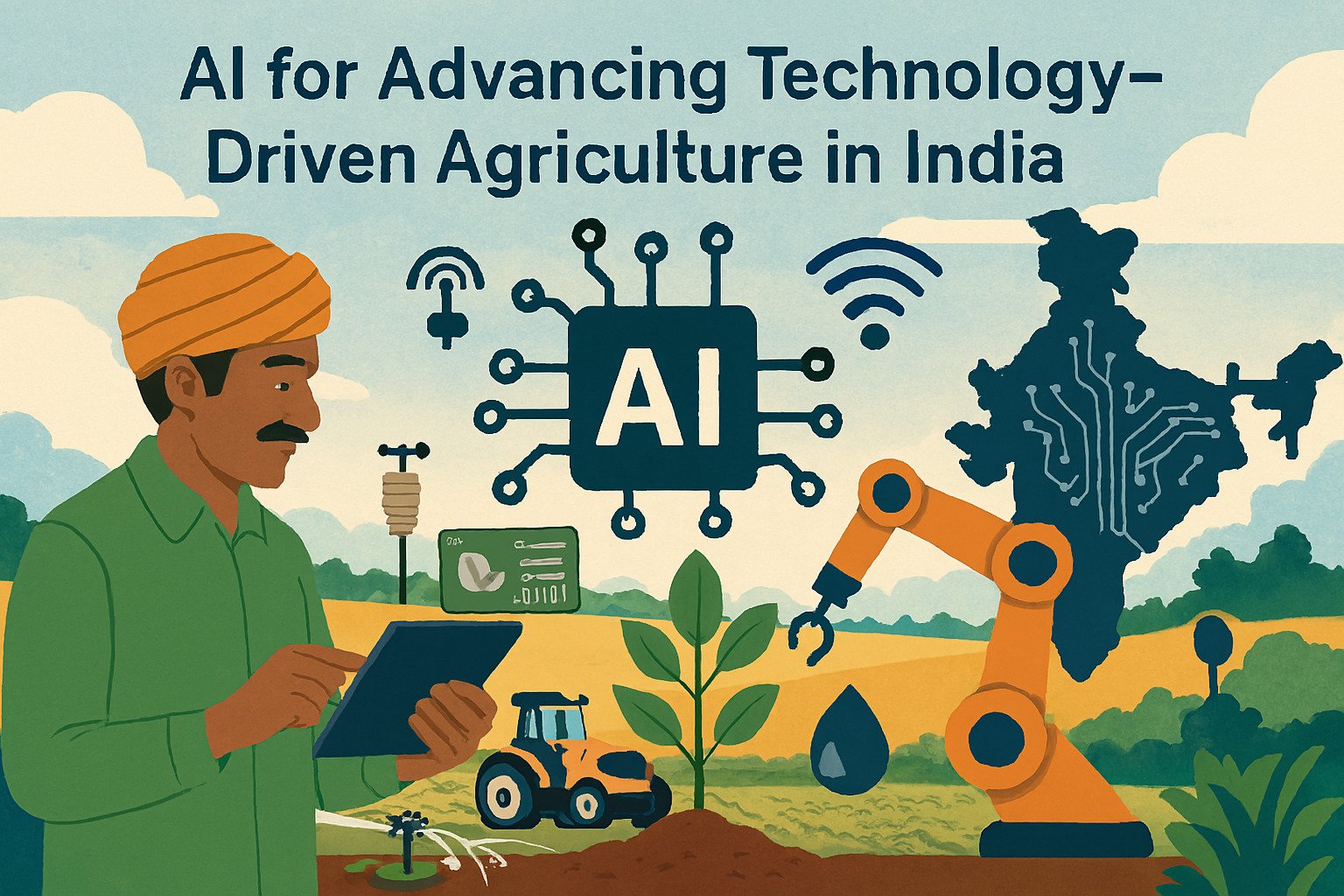
The financial year 2026-27 budget allocation for the development of AI (Artificial Intelligence) in agriculture indicates the government’s intention to keep up with the global trends in agriculture and commitment to innovating in a technology-driven era of farming.
The financial year 2026-27 budget allocation for the development of AI (Artificial Intelligence) in agriculture indicates the government’s intention to keep up with the global trends in agriculture and commitment to innovating in a technology-driven era of farming.
Finance Minister Smt. Nirmala Sitharaman in the Union Budget 2026-27 highlighted the launch of 1Bharat-VISTAAR, a multilingual AI-enabled platform designed to integrate AgriStack portals with the ICAR’s packages on agricultural practices with AI systems to democratize and contextualize knowledge, empower farmer voices, and amplify the collective wisdom of the ecosystem through exponential AI. This initiative aims to provide farmers with seamless access to region-specific, data-driven advisories, enhance decision-making, and improve productivity and sustainability across the agricultural value chain. By leveraging AI to bridge information gaps and support evidence-based farming, the government is showing steadfastness and reinforcing its vision of a resilient, inclusive, and future-ready agricultural ecosystem.
Given the current state of agriculture in India and scarce natural resources, increasing crop yields from the same land is becoming more challenging. Most fertile land is already under intensive cultivation, and the gains from fertilizers, irrigation, and improved crop varieties are reaching their limits. Continuous farming of similar crops has also led to soil degradation, loss of nutrients, and reduced water availability, which further restrict crop productivity. At the same time, climate change is adding new challenges to conventional farming practices. Rising temperatures, irregular rainfall, more frequent droughts and floods, and the spread of pests and diseases are directly affecting crop growth and stability of yields. These environmental changes make traditional agriculture less reliable and harder to sustain, highlighting that existing farming practices alone will not be enough to meet future food needs.
Some agricultural issues that are going to be more prominent in the coming years are listed as follows along with the AI-driven mitigation strategies:
Climate Change: The effects of climate change are already visible in the current agricultural system, and it is only going to worsen with time. Crop failures are now more frequent due to uncertain weather conditions, and the rising temperature is challenging conventional cropping cycles. To combat the adversities of climate change, climate-resilient strategies and AI solutions have to be developed, such as an AI assistant suggesting a cropping system to be chosen and the specific agronomic practices to be employed to mitigate the adverse climate responses.
Soil Health: Soil health is among the most significant fundamental requirements for good crop production; however, due to conventional agricultural practices and excessive use of chemical fertilizers, it’s deteriorating severely and, in certain cases, leading to desertification. To protect the soil health, AI interventions like soil pH sensors and AI models recommending recalibrated fertilizer doses and Integrated Nutrient Management (INM) approaches should be employed.
Market Access: The current agricultural ecosystem holds a very volatile and dynamic marketplace where market prices change on an hourly basis, and farmers have to resort to middlemen to secure at least that amount, which can bear the production costs due to lack of alternatives. To empower farmers with the ability to determine fair prices and participate as a true market force, multilingual AI-integrated marketplaces must be developed. These platforms can provide real-time price information, demand trends, and direct access to buyers across regions, reducing dependence on intermediaries.
Advanced Storage and Supply Chain Management: Another reason why farmers resort to the middleman for the sale of their produce in the market is because they lack access to storage facilities and a coherent supply chain to sell their produce to far-off places. Often perishable agricultural produce degrades in transit due to a lack of a formalized cold storage supply chain. To overcome this challenge, AI models should be developed that have data of all the regional storage units and have data of different supply chain providers for farmers to better store and transport their produce.
Crop Monitoring and Disease and Pest Detection: Every unit of yield loss leads to cascading economic impacts, including reduced farmer income, inefficient use of agricultural inputs, and overall decline in productivity. These losses often arise when regular crop monitoring is disrupted due to unforeseen circumstances. Crops remain highly vulnerable to pest and disease infestations, and once damage reaches an advanced stage, recovery of yield becomes impossible. To safeguard yield and stabilize farmer incomes, it is essential to deploy AI-driven models trained on comprehensive pest and crop disease datasets for early detection. Furthermore, systematic and continuous crop monitoring should be implemented through geospatial technologies to enable timely interventions and informed decision-making.
Harvesting Losses: One of the significant reasons for farmers' uneven income is post-harvest losses due to lack of knowledge of harvesting maturity and inability to predict the correct harvest maturity date. This barrier can be overcome by incorporating a predictive AI model in assessing true harvest maturity as well as personalizing pre-harvest practices for each farm to evade post-harvest losses.
Few of the above-mentioned issues are already in line with the mitigation strategies of the recently announced Bharat-VISTAAR AI model in the Union Budget 2026-27. However, the model needs to integrate AI into several other dimensions of the agriculture ecosystem, like soil health and post-harvest, to make farming a resilient enterprise in the changing environment.
Challenges and Limitations
Despite its potential, the adoption of AI in agriculture faces several challenges. High initial investment costs, limited digital infrastructure in rural areas, lack of technical knowledge, and concerns over data privacy can hinder widespread adoption. Addressing these challenges requires supportive government policies, farmer training programs, and affordable technology solutions.
In conclusion, the adoption of AI-based technologies must be carefully calibrated to optimize cropping systems and improve local production economics. Applying AI indiscriminately to every farm operation would only lead to inefficient use of resources. For instance, establishing a highly specialized AI-driven indoor cultivation system for a crop like cherry tomato, with automated irrigation and fertilizer management, may lead to inefficient economic returns; however, using the same conditions for a high-revenue crop like saffron. Therefore, integrating AI into India’s agricultural ecosystem demands precise and strategic implementation to achieve the best possible outcomes.